
Performers:
Elina Sitnikava, violin
Fernando Arias, violoncello
Enrique Lapaz, piano
PROGRAMME:
J. Brahms. Trio No. 3 in C minor, Op. 101
April Concert
Our April concert begins with Dmitri Shostakovich’s Sonata for Cello and Piano in D minor, Op. 40. The Russian composer wrote it in 1934, in the midst of a turbulent period in his personal life after falling in love with a young student. This led to a brief separation from his wife Nina, to whom he eventually returned. Shostakovich was obsessed with this work his entire life. He rewrote it frequently, until the moment of his death.
On the other hand, Johannes Brahms composed the second piece in the programme, Trio No. 3 in C minor, in 1886. In so doing, he achieved what many regard as the culmination of this genre, so characteristic of 19th-century German Romanticism. Successors and imitators attempted to achieve comparable excellence in their own works, but none displayed Brahms’s ability to combine profuse melodic invention with a mastery of technique that seemed entirely effortless.

Performers:
Felipe M. Rodríguez, violin I
Mercedes Dalda, violin II
Marco Ramirez, viola
Nuria Majuelo, cello
Susana Rivero, double bass
Guido García , organist
Lucía Beltrán, soprano
Andrea Rey, contralto
Daniel González, tenor
David Rubiera, bass
PROGRAMME:
G.B. Pergolesi (1710-1736) Stabat Mater Dolorosa
W.A. Mozart (1756-1791) Laudate Dominum, K 339 and Ave Verum Corpus, K 618
Bis, O. Gibbons (1583-1625) Drop, Drop, Slow Tears
Easter Week Concert
What better way to celebrate Easter Week than with a selection of some of the most emblematic works in sacred music? We are presenting a concert for string quintet and vocal quartet with an exquisite programme for the occasion. We will hear pieces of extraordinary beauty, such as Pie Jesu by Fauré, Mozart’s short motet Ave verum corpus, and Pergolesi’s moving Stabat Mater, along with other songs rich in spiritual meaning, such as There is and old belief, which expresses faith in the transcendence of mankind after death, and the devout Mother of God, here I stand. They are both emblematic pieces of the English vocal repertoire.
Performers:
Violeta Gil García, flute
Stanislas Kim, cello
Pablo Suárez Calero, violin
Bálint Váray, violin
Sandra García Hwung, viola
Luis Otero Herranz, double bass
Marie Rosa Günter, harpsichord
PROGRAMME:
Torment and Feeling
In the late 18th century, a literary movement emerged in Germany that celebrated nature, emotion, and human individualism. It sought to overthrow the Enlightenment’s cult of rationalism. This movement was called Sturm und Drang (torment and “feeling,” a German word difficult to translate literally).
Sturm und Drang became associated with literature or music intended to impact the audience or fill them with intense emotion. One of the greatest exponents of this movement was Carl Philipp Emanuel Bach (son of Johann Sebastian Bach), whose music, although similar to the Classical style, immerses us in a torment of feeling, taking us through contrasting emotional states in a very short space of time. On this occasion, we will hear how the composer treats two very different instruments in two of his most characteristic concertos.
Performers
Anne-Marie North, violin
Karina Azizova, piano
PROGRAMME
L.V. BEETHOVEN. Piano Sonata No. 7 in D Major, Op. 10 No. 3
C. FRANCK. Sonata for Violin and Piano in A Major
Musical Challenges
The two sonatas in the programme are a veritable tour de force for ORCAM’s soloists. The Austrian piano eminence Carl Czerny considered Sonata in D Major as a “grandiose” piece. Like so many other of Beethoven’s early works, it requires masterful technique to perform it. But that alone is not enough: an extraordinary sensitivity is required to properly play the sonata’s slow movement—arguably his first mature masterpiece. We might say the same of the technical requirements for Sonata for Violin and Piano in A Major by César Franck. On this occasion, this is because it was composed for violin virtuoso Eugène Ysaÿe.
Performers
Sopranos: Manon Chauvin and Vanessa García
Altos: Teresa López and Julieta Navarro
Tenors: Diego Neira and Eduardo Sánchez
Basses: Fabio Barrutia and Fernando Rubio
Piano and direction: Javier Carmena
PROGRAMME
POPULAR (ARR. NEMESIO CARRIL). Vinde picariñas.
POPULAR (ARR. JESÚS GURIDI). Hator, hator.
POPULAR (ARR: J. A. DONOSTIA) ¡Oi Bethleem!
POPULAR (ARR. ALBERT GUINOVART). Popular Christmas Carols: Rin rin rin; Brincan y bailan; Los peces en el río; No lloréis mis ojos, and Campanas de Belén
Villancicos del Norte (Christmas Carols from the North)
This season, the Chamber Music Programme’s traditional Christmas concert brings us northward in our country. With a selection of traditional Christmas carols related to Galicia and the Basque Country, we discover little-known pieces tied to our cultural heritage. At the same time, the audience will also have the opportunity to sing along with more traditional carols at the end of the concert.
Performers
Violin: Felipe Rodriguez and Pablo Suárez
Viola: Ivan Martin
Cello: Stanislas Kim and Carlos Sanchez
PROGRAMME
Schubert Quintet
The String Quintet in C Major is a masterpiece, not only of chamber music, but of all time. Composed for two violins, viola, and two cellos, it dates from 1828, the last year in the Viennese genius’ short life. He never heard it performed in concert. Unusually long at 60 minutes, the quintet exudes an aura of serene, autumnal contemplation. Its rich harmonic depth and the unique sound brought by the two cellos make it a one-of-a-kind piece.
See programme
Performers
Violin: Anne Marie North and Alexandra Krivobodorov
Viola: Blanca Esteban
Cello: Nuria Majuelo
Harp: Camille Levecque
Clarinet: Victor Díaz
Flute: María José Muñoz
PROGRAMME
A Miscellany of Sounds
In Mannheim in 1777, amateur flautist Ferdinand De Jean offered Mozart 200 gulden to write “three short and simple concertos and a few flute quartets.” The composer accepted the commission and wrote the quartet that inaugurates this concert. In one of his letters, Mozart confessed that he hated the sound of the flute. However, no one would believe him after listening to the lovely passages he has devoted to this instrument. He held the clarinet is higher regard, the star of the second quartet and one of his most well-known chamber works. Next comes the violin and harp’s turn, with Camille Saint-Saëns’ fantaisie (1907). The French musician shows us how instruments can complement one another in different ways as the piece moves forward. The programme closes with the work of another Frenchman, Maurice Ravel (1905), who brings all the previous instruments together, thus concluding our acoustic smorgasbord.
Programme
Performers
Trumpet: Germán Asensi and César Asensi
French horn: Anaís Romero
Trombone: Juan San Juan
Tuba: Josep Gómez
PROGRAMME
G FARNABY. The Old Spagnoletta
Performers
Soprano: Mercedes Lario
Alto: Sonia Gancedo
Tenor: Gabriel Arce
Baritone: Fabio Barrutia
Piano: Karina Azizova
Piano: José Segovia
Programme
BRAHMS. O Schöne Nacht, Op. 92
BRAHMS. Drei Quartette, Op. 64
BRAHMS. Ballade, Op. 118
BRAHMS. Liebeslieder Walze, Op. 52
Delicatessen by Brahms
Johannes Brahms is well-known for his vast catalogue of vocal music, ranging from lieder (songs) to large-scale choral pieces. Completed in 1884, his Opus 92 is an astonishing collection of songs inspired by poems from Goethe, Daumer, Allmers, and Hebbel. We will be hearing O schöne Nacht in this series. It describes a peaceful, starry night, while a young man goes to meet his lover, repeating: “Oh, what a beautiful evening!” Following is Drei Quartette Op 64, from 1874, which consists of three songs whose topics revolve around nostalgia for the homeland, nature, and love. Other exquisite creations by Brahms complete the concert. Exceptional pieces to conclude this selection.
Performers
Sopranos: María Jesús Prieto and Victoria Marchante.
Mezzo-soprano: Isabel Egea and Julieta Navarro
Tenors: Igor Peral and Diego Neira
Basses: Fabio Barrutia and David Rubiera
Piano: Javier Carmena, piano
PROGRAMME
CHUECA. Pasacalle (Cádiz)
CHUECA. Dúo, sevillanas y caleseras (Cádiz)
GUERRERO. Pasacalle de la escalera (La rosa del azafrán)
GUERRERO. Tango milonga (La montería)
MORENO TORROBA. Chotis del café (María Manuela).
ALONSO. Pasodoble de las horchateras (La de los ojos en blanco)
MORENO TORROBA. Mazurca (La Chulapona)
MORENO TORROBA. Pasodoble de la maestra (La Chulapona)
ALONSO. ¡Arrímate! (24 horas mintiendo)
GUERRERO. Fox trot (Los gavilanes)
GUERRERO. Rondalla de estudiantes (El canastillo de fresas)
ALONSO. La Colasa -tabaco y cerillas- (Las de Villadiego)
ALONSO. Marchiña (24 horas mintiendo).
ALONSO. Chotis (Rosa “la pantalonera”)
ALONSO. Serenata (La linda tapada)
ALONSO. Caleseras (La Calesera)

Concierto “¡Viva la Zarzuela!” de la Fundación Canal
Long Live Zarzuela!
Once again this year, the Chamber Music Series’ traditional Zarzuela concert offers an exceptional opportunity to savour the most well-known serenatas, pasacalles, rondas, and chotis in our theatre genre par excellence. This year, we are doing so with composers like Jacinto Guerrero, Francisco Alonso, and Federico Moreno Torroba, with the most Castilian titles in their repertoire.
Performers
Double basses: Luis Otero, Susana Rivero, José Antonio Jiménez, Zlatka Pencheva.
PROGRAM

Make way for the double bass
We may consider the double bass as a mere accompanying instrument, relegated to a secondary role in the orchestra. Nothing could be further from the truth! This concert challenges us to rethink this idea and to discover all its possibilities as an extraordinary solo instrument, capable of creating exceptional melodies. With this finding, arrangements based on well-known works by composers such as Wagner, Mussorgsky, Schubert, Elgar or Borodin, among others, will be performed. A unique opportunity to discover this wonderful instrument.
Interpreters
Iliana Machado, soprano
Julieta Navarro, mezzo-soprano
Daniel González, tenor
Fernando Rubio , bass
Lourdes Hige, oboe
Felipe Rodríguez y Gladys Silot, violin
Sandra García, viola
Carlos Sánchez, cello
Susana García, doouble bass
PROGRAM
J. S. BACH. Motet BWV 118 O
J. S. BACH. Mass Brevis in G minor BWV 236
Easter with Bach
“When I hear Bach’s music, I have the feeling that the eternal harmony speaks to itself, as it must have happened to God shortly before the creation of the world”, this is how Goethe would describe his perception of Bachian music and, in line with him, the program of this concert seeks to enrich and elevate the spiritual experience of Holy Week through the performance of two masterpieces by Johann Sebastian Bach.
with him, the program of this concert seeks to enrich and elevate the spiritual experience of Holy Week through the performance of two masterpieces by Johann Sebastian Bach.
Although the sublime choral piece that opens the concert,
O Jesu Christ, meins Lebens Licht, BWV 118, has often been considered a cantata, it is technically a motet. It was composed in 1736/37, but the occasion for which it was written is unknown. The source of the text is a 1610 hymn by Martin Behm,
Some say it was probably written for a funeral procession, some say it was played at Bach’s own funeral!
The next work on the program is the Missa Brevis in G minor
BWV 236, one of the five masses Bach wrote between 1737 and 1748. To compose it, he recycled some parts of his cantatas, thus offering us a small showcase of his extraordinary compositions.
Performers
Lourdes Higes and Lourdes Vigueras, oboes
Salvador Salvador and Víctor Díaz, clarinet
Sara Galán and Xaro Martínez, bassoon
Antonio Serrano and Francisco Rodríguez, basset horns
Christian Morabito, José Antonio Sánchez, Joaquín Talens, and Ángel Lechago, French horn
Francisco Ballester, double bass
PROGRAMME
W.A. MOZART
Serenade n. 10 in B flat major, K. 361/370a

Mozart’s “Gran Partita”
Serenade No. 10 in B flat major, K. 361/370a, more popularly known by the name “Gran partita,” partially due to its duration, around 50 minutes, was a turning point in chamber pieces for wind instruments. It was written for thirteen instruments: two oboes, two clarinets, two basset horns, two bassoons, four French horns and, as the sole string representative, a double bass. Including the basset horns, an instrument with a unique timbre developed just a few years earlier, is normally attributed to Mozart’s relationship with Freemasonry. This might suggest that this is a mature piece, written for his own delight. Despite its popularity, since thirteen performers are necessary, it is not regularly played in concert series. This is a score where active listening between the musicians is essential. Do not miss this opportunity to discover this exceptional score!
Performers
Elina Sitnikava, violin
Stanislas Kim, cello
Karina Azizova, piano
PROGRAM
S. RACHMANINOV. Trio élégiaque in G minor
P. I. TCHAIKOVSKY. Piano Trio in A minor “To the memory of a great artist, N. Rubinstein”.
DEAR MASTER…
Russian composers seemed to find in the piano trio the perfect vehicle for paying homage to their masters. Tchaikovsky was something of a mentor to the young composer and pianist Sergei Rachmaninov. His one-movement Trio élégiaque No. 1 dates from the year of his graduation, 1892, and is clearly inspired by Tchaikovsky’s Piano Trio in A minor (1881-82), which we will hear later. This, in turn, is a lament for the loss of pianist Nicolai Rubinstein, Tchaikovsky’s close friend and mentor.
But do not think that the story ends here, because, curiously, the death of Tchaikovsky himself, in 1893, would motivate Rachmaninov to return to this format by writing his second Trio élégiaque in memory of the master.
Performers
Hevila Cardeña, soprano
Teresa López, mezzo-soprano
Lorenzo Moncloa, tenor
Alfonso Baruque, bass
Karina Azizova, piano
PROGRAM
Jule Styne
Let It Snow
Jonny Marks
A Holly Jolly Christmas
Navarre Popular
Chiquirriquitín
Spanish Popular
The old lady is coming
Andalusian Popular
Bell on bell
Venezuelan folk
Mi burrito sabanero
English folk
We Wish You a Merry Christmas (arrangement by Karina Azizova)
Franz Schubert
Ave Maria
Franz X. Gruver
Silent Night
John Newton
Amazing Grace
Richard Rodgers
The Sound of Music
Wallace Willis
Swing Low
Joe Beal & Jim Boothe
Jingle Bells Rock
Irvin Berlin
White Christmas
James Pierpoint
Jingle Bells
PROGRAM NOTES
By Cristina Roldán, musicologist.
Festive Christmas potpourri
What better way to prepare for the arrival of Christmas than through a selection of Christmas carols? This concert is made up of the essential Christmas carols: popular Castilian carols that for centuries have been part of the usual repertoire, along with other foreign ones adopted today almost as our own.
Interpreters
MAITE RAGA , FLUTE
SANDRA GARCÍA , VIOLA
LAURA HERNÁNDEZ, HARP
PROGRAM
Jean-Philippe Rameau
Harpsichord Pieces in Concert (arrangement for flute, viola, and harp)
Jean-Marie Lecrair
Sonata No. 8 in D Major
Maurice Ravel
Minuet in Trio
Jacques Ibert
Two Interludes for flute, viola, and harp.
Claude Debussy
Sonata para flauta, viola y arpa
PROGRAM NOTES
By Cristina Roldán, musicologist
Echoes of France
The timbres of the viola, flute, and harp comprise the sound palette of this concert, as if they represented the three colors of the French flag that unite their composers.
Jean-Philippe Rameau, one of the greatest musicians of the French Baroque, never thought of using this combination. In his Harpsichord Pieces in Concert, he originally used this instrument as a soloist, alongside the violin and the viola da gamba. It was Claude Debussy who first chose this exclusive sonic material, which he experimented with in his Sonata, the most cherished in his repertoire. Jacques Ibert, just a few decades younger than him, borrowed it for his Two Interludes, which reveal a completely French sensibility in balance, color, and vivid impression. And although Maurice Ravel, often compared to Debussy, only thought of the piano for his Sonatina, Carlos Salzedo soon proposed an arrangement for these instruments that immediately thrilled him.
J. Brahms
Two songs with viola:
Gestillte Sehnsucht (F. Rückert), Op. 91 nº 1
Geistliches Wiegenlied (E. Geibel / Lope de Vega), Op. 91 nº 2
E. Mateu
El amor esquivo (voice, viola)
Tres canciones amorosas (voice, viola, piano)
F. Schubert
Viola/piano serenade
Christian Jost (voice, viola, piano)
Hamlet Echoes (Shakespeare / Schlegel / Jost)
Frank Bridge
Three songs with viola
Marta Knörr, mezzo-soprano
Eva Martín, viola
Aurelio Viribay, piano
Interpreters
Marta Knörr, mezzo-soprano
Eva Martín, viola
Aurelio Viribay, piano
PROGRAM NOTES
By Cristina Roldán, musicologist
Musical Delights
The beautiful program of this concert invites us to travel from the Romantic era to the present day with the mezzo-soprano’s voice and the sound of the viola as protagonists, occasionally accompanied by the piano. They whisper to us some of the most timeless texts in universal literature.
The words of the German poet Friedrich Ruckert intertwine with those of Lope de Vega, Shakespeare, or the Austrian Franz Grillparzer, among others. Brahms’ love songs, Mateu’s works, Hamletian echoes from the German Christian Jost, Schubert’s serenade, and three romantic songs by the Englishman Frank Bridge that constitute true musical delights.
A. Arensky
Quintet Op.51
J. Brahms
Quintet Op. 34
Performers
Rocío García, violin
Robin Banerjee, violin
José Antonio Martínez, viola
Stanislas Kim, cello
Karina Azizova, piano
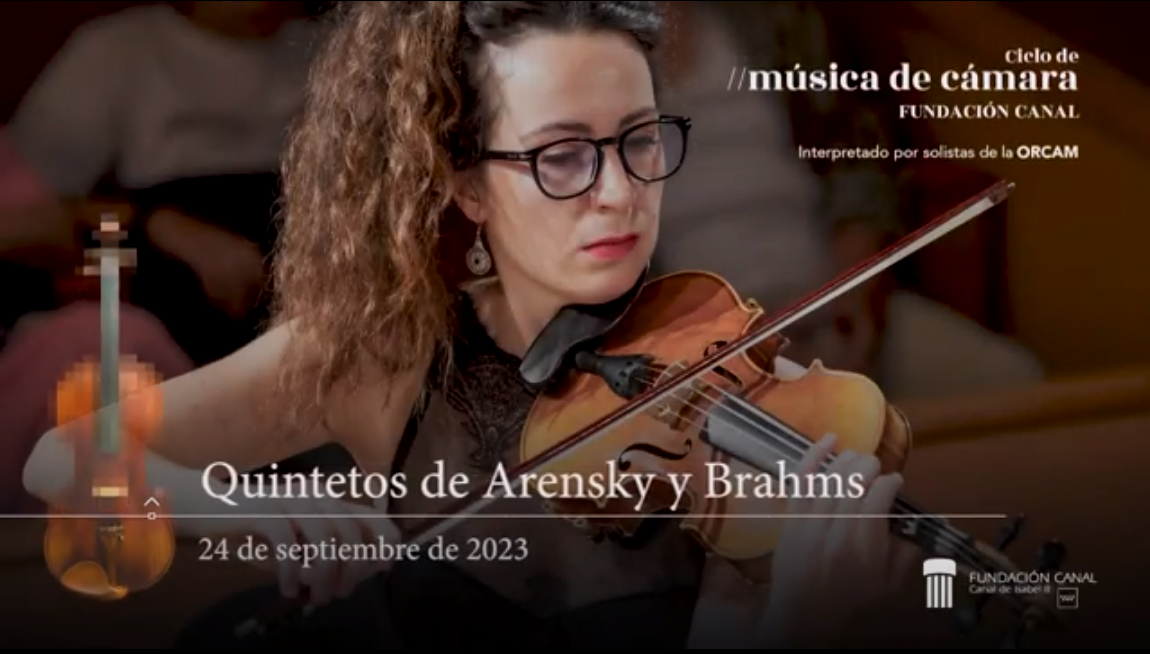
PROGRAM NOTES
The Exuberance of the Quintet
The coupling between Russian and German styles is extraordinarily represented in this program, with two of the best chamber pieces by Anton Arensky and Johannes Brahms.
They both use a combination of string and piano quartet that make the quintet a particularly powerful ensemble, since it brings together two forces that are self-sufficient on their own. Arensky delights us with an exuberant score for piano that the strings follow with elegance, and Brahms offers a dark, powerful work with tremendous scope, considered a great monument in chamber music that he completed when he was only thirty-one years old.
W. A. Mozart
Sonata KV304 (violin and piano)
L. v. Beethoven
Scottish Songs Op.108 (tenor, violin, violoncello, piano)
J. Turina
Classical variations Op. 72 (violin and piano)
J. Centeno/ K. Farhan
Moriré de Madrid (tenor, violin, piano)
K.Farhan- M. Comesaña
A la ciudad llegaron mares (tenor, violin, piano) Karim Farhan – Juan Durán: Quédate (tenor, violin, piano)
Performers
Víctor Arriola, violin
Juan Carlos Cornelles, piano
Karim Farham, tenor
Rafael Dominguez, cello
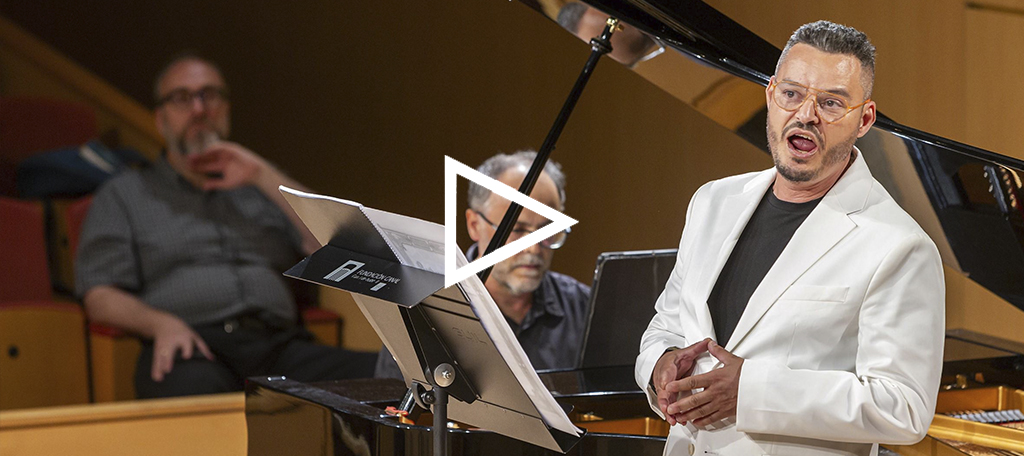
PROGRAMME NOTES
Musical Rarities
An exceptional combination of instruments sets this program apart. The violin and the piano share a dialogue in Sonata in E minor, K. 304 by Mozart (1778), the only one he wrote in a minor tone, giving it an unusual gravity in his repertoire.
Then, the tenor’s voice and the sound of the violoncello join, only participating in Beethoven’s Scottish Songs (1818-1822). The German man wrote nothing short of 179 arrangements of popular songs, including these striking pieces. After these two classical composers par excellence, we continue exploring the astonishing possibilities between the tenor, violin, and piano with Joaquín Turina, rounding off with three contemporary pieces expressly composed for this grouping.
F. A. Barbieri
“Cuarteto de caleseras”, El barberillo de Lavapiés
F. A. Barbieri
“Esto es el sitio frente a la vena”, El barberillo de Lavapiés
R. Chapí
“Cuando está tan hondo”, El barquillero
F. Alonso
“Ni siquiera lo puedo pensar”, Rosa la pantalonera
F. Alonso
“Canción del borrico”, La linda tapada
M. Penella
“Todas las mañanas”, Don Gil de Alcalá
P. Sorozabal
“No puede ser”, La tabernera del puerto
R. Chapí
“Yo soy la pitillera de más primores”, Música clásica
A. Vives
“La niña de ojos azules”, Bohemios
P. Sorozabal
“Despierta negro”, La tabernera del puerto
R. Chapí
“Dúo Felipe y Mari Pepa”, La revoltosa
Performers
Hevila Cardeña, soprano
Julieta Navarro, mezzosoprano
Lorenzo Moncloa, tenor
Alfonso Baruque, bass
Karina Azizova, piano
PROGRAM NOTES
Scenes from “Madriz”
Great monuments in the history of the zarzuela come together in this emblematic program that gathers a selection of classics like El barberillo de Lavapiés, Don Gil de Alcalá, La tabernera del puerto, and La revoltosa. Famous pieces by Barbieri, Chapí, Alonso, Sorozábal, and more, who revolutionised Madrid’s stages in the 19th and 20th centuries, bringing the genre to its glory days.
A. Dvorak
String quintet Num. 2 Op. 81
S. Prokofiev
Quintet Op.39
Performers
Felipe Rodríguez, violin
Balint Varay, violin
Sandra García Hwung, viola
Carlos Sánchez, violoncello
Susana Rivero, double bass
Víctor Díaz, clarinet
Lourdes Higes, oboe
PROGRAM NOTES
Bold Musical Acrobatics
The quintet for piano and strings is one of the most powerful and flexible ensembles in the history of music. The different combinations afforded by the piano and all of the string instruments, and the possibility of alternating protagonism between each one of them, make them worthy of this fame. Quintet Num. 2 Op 81 by Dvorák is one of the best examples of late Romanticism using all this potential to its best advantage.
Written between August and October 1887, this was no the composer’s first time trying his hand at writing for five instruments, but it was the first time he definitively made a name for himself. On the other hand, the Quintet Op. 39 by Prokófiev comes from a commission given to the composer by a Russian dancer in 1924. He was to set music to some short choreography sets performed by artists in a travelling circus. The result is dazzling and seems to simulate an entire acrobatic display.
G. Pergolesi
Stabat Mater, for soprano/alto string and organ quintet
G. Donizetti
Parafrasi del Christus, for soprano/alto string and organ quintet
PROGRAM NOTES
A Mother’s Cry
Can music express a mother’s pain when she loses a child? The Stabat Mater (in Latin, “The Mother Was There”) is a meditation on the Virgin Mary’s suffering when Jesus was crucified. This has acted as inspiration for composers such as Palestrina, Haydn, and Rossini, although Giovanni Battista Pergolesi’s is certainly the most oft performed. Although he wrote it on his deathbed, the composer managed to create his most popular piece, bringing together the austerity and simplicity one would expect from religious music with an innovative vocal score more operatic in style. Gaetano Donizetti also wanted to put music to the moment of crucifixion, and he did so over a text by Serafino Gatti in Parafrasi del Christus. Just like Pergolesi, Donizetti pushes the limits of sacred music, creating a sort of religious opera. Curiously enough, it begins in F minor, like his piece.
Performers
Manon Chauvin, soprano Teresa López, alto Rubén Reina, violin
Felipe Manuel Rodríguez Padilla, violin Jose Antonio Martínez, viola
Nuria Majuelo, cello Susana Rivero, double bass
Vanessa Pérez, organ
H. Villa – Lobos
Poema da criança a sua mamá (flute, clarinet, cello, and vocals)
C. Guastavino
Introduction and Allegro for flute and piano
H. Villa – Lobos
Chorus num. 2 for flute and clarinet
C. Guastavino
Tonada y Cueca (clarinet and piano)
C. Guastavino
Sonetos del ruiseñor (flute, clarinet, cello, piano, and vocals)
PROGRAM NOTES
Sounds of Brazil and Argentina
Many composers attempted to blend characteristic elements of Brazil, a true kaleidoscope of cultures and styles, with European musical techniques, but few managed such a unique and personal integration as Heitor Villa-Lobos; his two pieces included in this concert prove this. While Villa-Lobos’ music brings us on a journey to Brazilian lands, the music of Carlos Guastavino, also known as the “Schubert of the Pampas,” perfectly evokes the landscapes of his native Argentina, shining with simple yet intense melodies.
Performers
María Teresa Raga, flute
Salvador Salvador, clarinet
Carlos Sánchez, violoncello
Karina Azizova, piano
Sandra Cotarelo, soprano
Vocal repertoire of Rachmaninoff on the 150th anniversary of his birth
Do not sing to me, my beauty
In the silence of the secret night
Lilacs
Don’t believe me, friend!
Elégie (piano solo)
Polichinelle (piano solo)
Morning
Child, you are beautiful like a flower
I fell in love, to my sorrow
She is as beautiful as midday
Étude-Tableaux N5 (piano solo)
Étude-Tableaux N9 (piano solo)
All things pass
Vocalize
Spring waters
Performers
Karina Azizova (piano)
Ekaterina Antipova (voice)
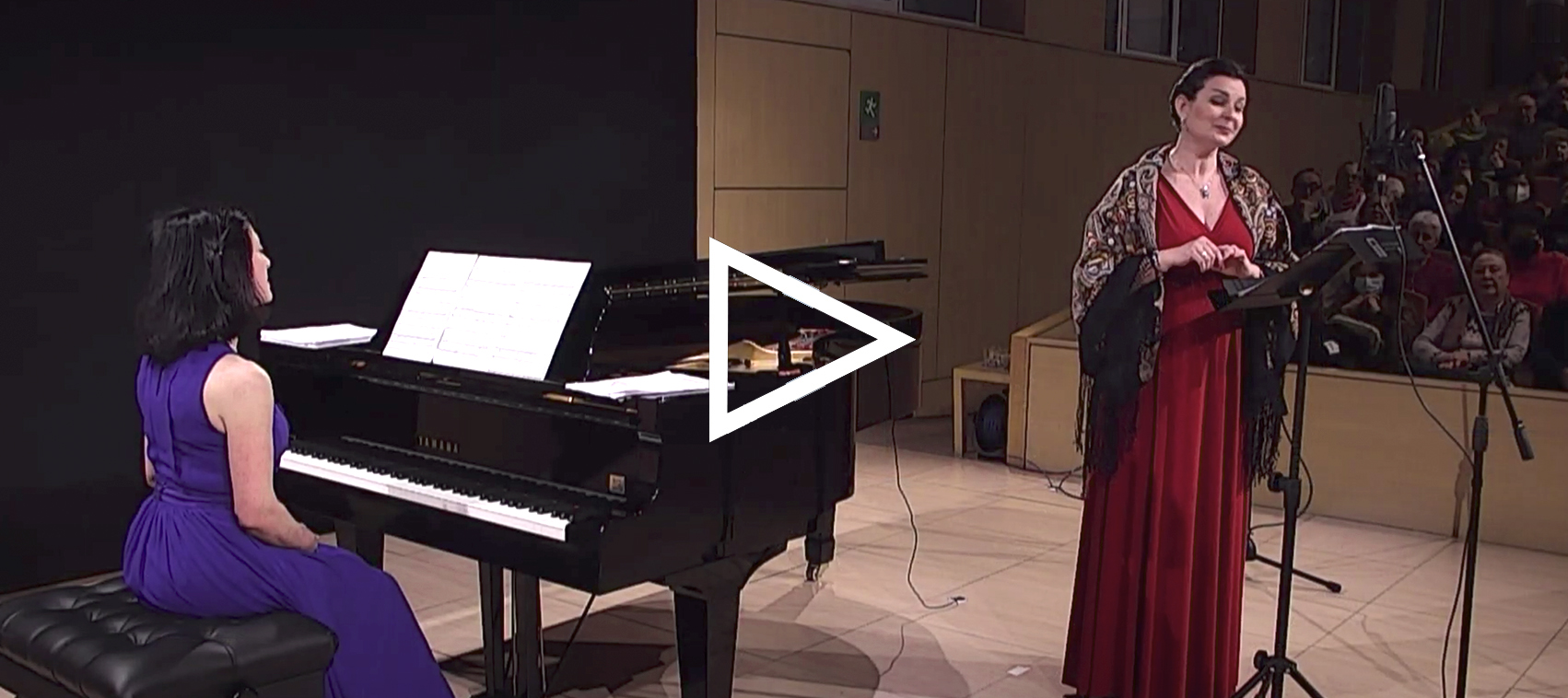
PROGRAM NOTES
The delicate voices of Rachmaninoff
Often, when we speak of Sergei Rachmaninoff, the last representative of Russian romanticism, we speak of his great piano pieces, with those gushing melodic lines and resounding harmonies. In this concert, we pay tribute to a lesser-known Rachmaninoff on the 150th anniversary of his birth, the Rachmaninoff who wrote nothing short of eighty beautiful songs for voice and piano between 1890 and 1916. Nature was the source of his inspiration. He confessed: “I compose slowly, surrounded by nature. My eyes drink in the sparks of light on the fresh leaves after the rain; my ears, the whispering of the forest. I observe the pale hues of the sky in the horizon after the sun sets, and in my soul, voices emerge, all at once…in a song.”
A. Lobo
T. L. de Vitoria
F. Guerrero
C. de Morales
Popular Christmas Carols
PROGRAM NOTES
The “Golden Age” of Spanish music bore witness to surprising musical development, worthy of its economic pre-eminence over the rest of the 17th-century world. Focusing on music for Christmas and the Epiphany, ORCAM is exploring this rich musical treasure. One same programme boasts an irresistible blend of sumptuous harmonies with popular dances, bringing truly infectious joy. The concert’s central piece, Misa a 6 voces Beata Dei genitrix, for Christmas Matins, by fantastic Sevillian composer Alonso Lobo, has yet to earn all the praise it is due. This composition bursts with richness and light. Between movements, there are Christmas motets by Tomás Luis de Vitoria, Francisco Guerrero, and Cristóbal de Morales, along with an exuberant Ensalada de juventud by Mateo Flecha “El Viejo” to celebrate the birth of Jesus, in addition to traditional Christmas Carols set to popular tunes.
Performers:
Sandra Cotarelo and Paloma Friedhoff. Sopranos
Sonia Gancedo and Teresa López Tabar. Altos
Fran Braojos. Tenor
Simón Andueza. Baritone and Direction.
A. Lobo
T. L. de Vitoria
F. Guerrero
C. de Morales
Popular Christmas Carols
PROGRAM NOTES
The “Golden Age” of Spanish music bore witness to surprising musical development, worthy of its economic pre-eminence over the rest of the 17th-century world. Focusing on music for Christmas and the Epiphany, ORCAM is exploring this rich musical treasure. One same programme boasts an irresistible blend of sumptuous harmonies with popular dances, bringing truly infectious joy. The concert’s central piece, Misa a 6 voces Beata Dei genitrix, for Christmas Matins, by fantastic Sevillian composer Alonso Lobo, has yet to earn all the praise it is due. This composition bursts with richness and light. Between movements, there are Christmas motets by Tomás Luis de Vitoria, Francisco Guerrero, and Cristóbal de Morales, along with an exuberant Ensalada de juventud by Mateo Flecha “El Viejo” to celebrate the birth of Jesus, in addition to traditional Christmas Carols set to popular tunes.
Performers:
Sandra Cotarelo and Paloma Friedhoff. Sopranos
Sonia Gancedo and Teresa López Tabar. Altos
Fran Braojos. Tenor
Simón Andueza. Baritone and Direction.
R. Strauss
Andante Op. Posth.
C. Nielsen
Fantasy Pieces for Oboe and Piano Op. 2
C. Reinecke
Trio for Piano, Oboe and Horn Op. 188
R. Schumann
Novelette No. 8 Op. 21
H. Von Herzogenberg
Trio for Piano, Oboe and Horn Op. 61
PROGRAM NOTES
A concert for piano, French horn, and oboe, bringing together pieces that range from German Romanticism (both early Romanticism, like Schumann, and late Romanticism, like Strauss) to some of the most well-known European composers of the late 19th and early 20th centuries, such as Denmark’s C. Nielsen and Austria’s Von Herzogenberg.
Performers:
Lourdes Higes. Oboe
Pedro Jorge. French horn
Karina Azizova. Piano
A concert in tribute to the essential importance of water in our lives. One of its most fantastic attributes is that you can travel through it, as shown on this hilarious boat voyage from Venice to Padua, fruit of Adriano Banchieri’s (1568-1634) astonishing imagination.
Barca di Venetia per Padova was first printed in Venice in 1605 by Ricciardo Amadino. It is the seventh secular music anthology by Adriano Banchieri, an Olivetan monk from S. Michele at the Bosco monastery of Bologna, one of the most well-known and theoretical composers of music in the early 17th century. Of all his works defined as madrigal comedies, the Barca stands out for its rich, complex narrative framework that encapsulates musical pieces. This fantastic mini madrigal opera, infused all the way through with humour, has many different characters. They are split between boat representatives and passengers.
Performers:
Sandra Cotarelo and Paloma Friedhoff. Sopranos
Sonia Gancedo and Teresa López Tabar. Altos
Fran Braojos. Tenor
Simón Andueza. Baritone and Direction
Vivaldi
Sinfonia for strings in C major (approx. 5′)
S. Bach
Brandenburg Concerto No. 5 BWV 1050, flute, violin, and harpsichord soloists
S. Bach
Double concerto for oboe and violin BWV 1060 in D minor
Vivaldi
Concerto for flute and strings in D major Rv 433, op. 10 No. 1
Vivaldi
Concerto for oboe and strings in A minor, Rv 461
PROGRAM NOTES
Venetian Vivaldi is one of the greatest Baroque composers. A prolific creator, he composed around 770 works, which include approximately 400 concertos and nearly 50 operas. In addition to his own personal contribution, Vivaldi is also known for his profound influence on Germany’s Bach, whose work is considered the height of Baroque music. In this concert, these two geniuses “face off” so we can enjoy their work and see how their interactions have benefited music.
Performers:
María José Muñoz. Flute and Piccolo
Ana María Ruiz. Oboe
Anne Marie North. Violin
Alexandra Krivoborodov. Violin
Gladys Silot. Violin
Blanca Esteban. Viola
Nuria Majuelo. Cello
Susana Rivero. Counter-bass
Karla Martínez. Harpsichord
Georg Philipp Telemann
Suite
– Don Quijote
Luigi Boccherini
Divertimento No. 5 op 8 in D major
Jean Sibelius
Impromptu op 5 for string orchestra
P. Tchaikovsky
String serenade Op. 48
PROGRAM NOTES
The ORCAM Foundation string orchestra is performing a diverse, appealing programme. It includes pieces that range from Baroque music, represented by German composer G. P. Telemann, to the romanticism of Russia’s Tchaikovsky or Finland’s Sibelius, along with the 18th century’s Galant style, thanks to the divertimento composed by the Italian Boccherini.
Performers:
Violins I: Maceo Reynaldo, Gladis Silot, Felipe Manuel, Alexandra Krivoborodov
Violins II: Osmay Torres, Robin Banerjee, Magaly Baro
Viola: Jose Antonio Martínez, Sandra García
Violoncello: Stamen Nikolov
Counter-bass: Susana Rivero
Alonso
Una mujer madrileña, from Me llaman la presumida.
Alonso
Yo soy Lucinda, from Tres días para quererte.
Moreno Torroba
Piropo madrileño, from María Manuela.
Alonso
Habanera,from La cuarta de Apolo.
Alonso
Caleseras, from La Calesera.
Moreno Torroba
Las mujeres españolas, from María Manuela.
Alonso
Claveles granadinos, from Veinticuatro horas mintiendo.
Alonso
Pasacalle de los chisperos, from La Calesera.
Luna
Soy la chula madrileña, from La chula de Pontevedra.
Alonso
Serenata, from Coplas de Ronda.
Alonso
Palabritas de cariño, from Tres días para quererte.
Alonso
Pasodoble, from La Zapaterita.
Soutullo and J. Vert
Pasacalle de las mantillas, from El último romántico.
Moreno Torroba
Pasacalle, from de La chulapona.
PROGRAM NOTES
With mythical zarzuela composers such as Francisco Alonso, Federico Moreno Torroba, and Pablo Luna, this concert brings together a series of emblematic pieces that shine a special spotlight on women. These works provide spectators with the opportunity to see the broad range of female roles in popular music during the first half of the 20th century, with beloved characters like the chulapa.
Performers:
María Jesús Prieto, Victoria Marchante. Sopranos
Isabel Egea, Julieta NAvarro. Mezzo-sopranos
Igor Peral, César Arrieta Tenores Fabio Barrutia, David Rubiera. Basses
Javier Carmena. Piano
L.V Beethoven
Irish songs WoO 152. Selection
V. Williams
Along the field. Selection
J. Brahms
Gestillte Sehnsucht de Zwei Gesänge
H. Berlioz
La captive
C. Saint Saëns
Violons dans le soir
B. Martinu
Primrose
V. Weigl
Songs newly seen in the dusk. Selection
J. Marx
Du bist der Garten
F. Bridge
Music when soft voices die
R. Miranda
Cantares
M. de Falla
Seven popular Spanish songs.
PROGRAM NOTES
The poetic ambience of Saint Saëns’ song, where the violin strings and bows meld with the singing of nature and expression of the voice, is the epigraph to this concert that explores conjunction of voice with string instruments. The two female singers, along with the violin, the violoncello, and the piano in multiple different combinations, create sound atmospheres through poetic texts set to music by renowned composers like Beethoven, Brahms, Berlioz, Saint Saëns, and Falla. At the same time, we discover other jewels from lesser-played authors, such as Vaughan Williams, Frank Bridge, Bohuslav Martinu, and others lesser-known, such as Joseph Marx, Ronaldo Miranda, and composer Vally Weigl.
Performers:
Paz Martínez . Contralto
Joana Thomé. Mezzo-soprano
Victor Arriola. Violin
Rafael Domínguez. Violoncello
Juan Carlos Cornelles. Piano
F. Mendelssohn
Trio for piano in D minor, Op. 11
C.W -Schumann
Trio for piano in G minor, Op. 17
PROGRAM NOTES
Concerto that showcases the talent and inspiration of women composers of German Romanticism, with the inclusion of two essential trios from the catalogue of works by composers Fanny Mendelssohn (Hamburg, 1805 – Berlin, 1847) and Clara Wieck Schumann (Leipzig, 1819 – Frankfurt, 1896).
Performers:
Ema Alexeeva. Violin
Nuria Majuelo. Violoncello
Karina Azizova. Piano
W.A. Mozart
Quintet in C Major KV515
W.A. Mozart
Quintet in G minor KV516
Performers:
Gladys Silot. Violin
Felipe Manuel Rodríguez. Violin
Eva Martín. Viola
Iván Martín. Viola
Ángel García Jermann. Violoncello
PROGRAM NOTES
The Quintets for string quartet and a second viola are a small corpus of singular significance in Mozart’s art. Like the fifth voice in the motets and madrigals of the 16th and 17th centuries, the fifth instrument added a new dimension to predominant chamber music education, with depth of thought and quality in texture. This provides greater variety in dialogues and new, ingenious combinations in harmony and counterpoint.
W.A Mozart
Trio in E-flat major K.498
R. Schumann
Märchenerzählungen Trio Op. 132
M. Bruch
5 pieces Op. 83
Performers
Salvador Salvador. Clarinet
Eva Martín. Viola
Karina Azizova. Piano
PROGRAM NOTES
Fairy Tales, the Bowling Trio: lovely monikers for marvellous music. The first known composition in music history for clarinet, viola, and piano is the Kegelstatt or Bowling Trio Op. 498 by Mozart. The famous moniker comes from a legend that says Mozart composed this trio while bowling. It was first performed (with Mozart himself on the viola) at the Jacquin family’s home and was dedicated to one of their daughters.
Märchenerzählungen, or Fairy Tales, Op. 132, were written by Schumann shortly before entering the sanatorium where he spent the last years of his life and are one of his last compositions. Although composed before his suicide attempt, the music is concise and joyful.
The 8 Pieces for clarinet, viola, and pinao Op.83 by Bruch perfectly align with Schumann’s romantic spirit and his Fairy Tales. On this occasion, we will hear pieces 1, 3, 5, 7, and 8.
I
Benjamin Britten
A Ceremony of Carols
– Procession (Hodie Christus Natur est), Gregorian Antiphon
– Christmas Eve Del Magnificat
– Wolcum
– There is No Rose
– That Yonge Child
– Balulalow
– As Dew in April
– This Little Babe
– Interlude (harp solo)
– In Freezing Winter Night
– Spring Carol
– Deo Gracias
– Recession (Hodie)
II
John Rutter
Christmas Lullaby
Nativity Carol
Gustav Holst
In the Bleak Midwinter
Bob Chilcott
Tomorrow shall be my dancing day
The marvelous birth
Kristen Allred
The Infant King
Dave and Jean Perry
A Festive Noel
Mark A. Brymer
Santa Baby
Alex Anderson
Mele Kalikimaka
Victor C. Johnson
African Noel
Philip Hagemann
Fruitcake
PERFORMERS:
Victoria Marchante, María Jesús Prieto, Sandra Cotarelo and María Caneda, sopranos.
Carmen Haro, Anabel Aldalur, Ana Cristina Marco, Sonia Gancedo and Marta Bornaechea, mezzo sopranos.
Karina Azizova, piano.
Alfredo Anaya, percussion.
Laura Hernández, harp.
Celia Alcedo, director.
I
Benjamin Britten
A Ceremony of Carols
– Procession (Hodie Christus Natur est), Gregorian Antiphon
– Christmas Eve Del Magnificat
– Wolcum
– There is No Rose
– That Yonge Child
– Balulalow
– As Dew in April
– This Little Babe
– Interlude (harp solo)
– In Freezing Winter Night
– Spring Carol
– Deo Gracias
– Recession (Hodie)
II
John Rutter
Christmas Lullaby
Nativity Carol
Gustav Holst
In the Bleak Midwinter
Bob Chilcott
Tomorrow shall be my dancing day
The marvelous birth
Kristen Allred
The Infant King
Dave and Jean Perry
A Festive Noel
Mark A. Brymer
Santa Baby
Alex Anderson
Mele Kalikimaka
Victor C. Johnson
African Noel
Philip Hagemann
Fruitcake
PERFORMERS:
Victoria Marchante, María Jesús Prieto, Sandra Cotarelo and María Caneda, sopranos.
Carmen Haro, Anabel Aldalur, Ana Cristina Marco, Sonia Gancedo and Marta Bornaechea, mezzo sopranos.
Karina Azizova, piano.
Alfredo Anaya, percussion.
Laura Hernández, harp.
Celia Alcedo, director.
Johann Sebastian Bach
Herz und Mund und Tat und Leben, BWV 147
– Jesus bleibet meine Freude (Choral)
Magnificat
– Et misericordia (Duo)
Wachet auf, ruft uns die Stimme, BWV 140
– Gloria sei dir gesungen (Choral)
George Friederich Händel
Messiah, HWV 56
– I know that my Redemer liveth (Air)
Jephtha, HWV 70
– Waft her, angels, through the skies (Air)
Felix Mendelssohn
Elias, Op. 70
-Die Tiefe ist versieget!… (Rezitative)
-Herr, höre unser Gebet (Duett)
-Zerreißet eure Herzen… (Rezitative)
-So ihr mich von ganzem Herzen suchet (Arie)
-Was hast du an mir getan (Rezitative, Arie und Duett)
-Herr Gott Abrahams, Isaaks und Israels (Arie)
-Wirf dein Anliegen auf den Herrn (Quarttet)
-Weh ihnen, daß sie von mir weichen (Arioso)
-Es ist genug! So nimm nun, Herr (Arie)
-Wohlan, alle, die ihr durstig seid ( Quarttet)
PERFORMERS:
Sandra Cotarelo, Soprano
Anabel Aldalur, Mezzo soprano
Gerardo López, Tenor
David Rubiera, Baritone
Javier Carmena, Pianist
Vivaldi
– Concerto for piccolo in C Major Op. 4
– Allegro
– Largo
Allegro molto
(Piccolo: Mª José Muñoz))
Marcello
– Concerto for oboe in D minor
– Andante
– Adagio
– Presto
(Oboe: Ana Ruiz)
Sebastian Bach
Suite 2 in B minor
– Ouverture
– Rondeau
– Sarabande
– Bourrée I/II
– Polonaise (Lentement)
– Double
– Minuet
– Badinerie
(Flute: Mª José Muñoz)
PERFORMERS:
Anne M. North, violin I
Alexandra Krivoborodov, violin II
Blanca Esteban, viola
Nuria Majuelo, violoncello
Susana Rivero, double bass
Ana Mª Ruiz, oboe
Mª José Muñoz, flute and fife
Vivaldi
Sonata in G Major
– Allegro
– Larghetto
– Allegro
Quantz
Sonata in C minor
– Andante moderato
– Allegro
– Larghetto
– Presto
Philipp E. Bach
Trio in E Major
– Allegretto
– Adagio Molto
– Allegro Assai
Sebastian Bach
Sonata Trio in D minor
– Adagio
– Allegro
– Largo
– Vivace
PERFORMERS:
Mª Teresa Raga, flute
Mª José Muñoz, flute
Núria Majuelo, violoncello
José Segovia, keys
La Gran Vía: piano solo introduction
La Gran Vía: Safety Waltz
La Gran Vía: Sergeants’ Paso Doble
Bateo: Organ grinder potpourri
El año pasado por agua: Neptune’s Waltz
Agua, azucarillos y aguardiente: piano solo interlude
El chaleco blanco: Washerwoman’s Chorus
Bateo: Wamba’s Tango
Agua, azucarillos y aguardiente: Nursemaid’s Choir
Bateo: The photographer’s polka
Agua, azucarillos y aguardiente: Quartet
PERFORMERS:
María Jesús Prieto, Vanessa García, sopranos
Marta Knörr, Isabel Egea, mezzosopranos
Igor Peral, Fran Braojos, tenors
Alfonso Baruque, bass
David Rubiera, baritone
Karina Azizova, piano
Script by José Prieto Marugán
Narrator: Marta Knörr
The concert will be recorded for later broadcasting. The online version will be available soon.
Robert Schumann
So war di sonne scheinet (Minnespiel op. 101)
Robert Schumann
Spanisches Liederspiel op 74
Johannes Brahms
Intermezzo n.2 op 118 (piano solo)
Johannes Brahms
Zigeunerlieder op. 103
PERFORMERS:
Mercedes Lario and Sandra Cotarelo, soprano
Sonia Gancedo and Julieta Navarro, contralto
Igor Peral and Víctor Sordo, tenor
Fernando Rubio and David Rubiera, bass
Javier Carmena, piano
Schumann
Adagio und Allegro Op. 70 (French horn and piano)
Wieck
Scherzo n.2 (piano solo)
Brahms
Scherzo (violin and piano)
Brahms
Horn Trio Op. 40 (French horn, violin and piano)
PERFORMERS:
Pedro Jorge, French horn
Anne Marie North, violin
Karina Azizova, piano
Quintet for piano in C flat, Op. 44
I. Allegro brillante
II. In modo d’una marcia. Un poco largamente
III. Scherzo: Molto vivace
IV. Allegro ma non troppo
Invierno Porteño (violin, violoncello and piano)
Cantique de Noël
Brincan y bailan
White Christmas
Shchedryk (Ukrainian carol)
Joy to the World”
Silent Night
Interpreters:
Reynaldo Maceo, violin I
Robin Banerjee, violin II
José Antonio Martínez, viola
Stamen Nikolov, violoncello
Karina Azizova, piano
4 Caetana Fantasies for oboe, violin, viola and violoncello.
String Trio, K 563 in E flat major
Quartet for English horn and strings.
28/06/2026
4,50€
All funds raised from the Chamber Music Programme 2026 shall be allocated to the project Dual Pathology Day Centre, by the FOUNDATION PROYECTO HOMBRE MADRID.


Find out about all our activities through our newsletter (only in Spanish) or social media channels. Don’t miss out. Subscribe and follow us.