


We’re going in the right direction, but at the wrong speed.
Once per year, the environmental clocks of practically every country on earth stop to sync at the United Nations Climate Change Conference (COP): an international summit whose purpose is to define, specify, and assess execution of efforts to protect the climate.
Global commons, limited and vulnerable
They belong to everyone, but run the risk of being protected by no one. This means that global commons like the atmosphere, the high seas, climate, and biodiversity (which affects all of humanity when it deteriorates, but which also knows no borders) require international dialogue forums to address how to care for them at planetary scale.
The rules of the game for dialogue, making decisions, and then applying them, are different from the rules that govern individual countries’ legal systems. In addition to maxims such as cooperation and prevention, interaction between countries requires that we couple principles like the sovereignty of every nation over its natural resources with other principles. These principles include the country’s “responsibility” to ensure that the activity occurring within its borders does not damage the environment.
While consensus between countries in environmental decision-making can make negotiations difficult, it also ensures that everyone supports the result and is more likely to hold up their end of the agreement. To move forward on climate issues, we need a great deal of dialogue (which is what the COPs are for) and to build stronger consensus.
Climate summits
At this international event, countries find shared spaces where they can build dialogue and cooperation. This translates to multilateral agreements and international conventions, along with the protocols or deals that stem from them. Such is the case of the United Nations Framework Convention on Climate Change (the result of the famous Rio Earth Summit (1992)) and its implementation through the more widely known Kyoto Protocol (1997) and the Paris Agreement (2015), with specific commitments for the parties. These parties are the nations who ratified the documents, and they bind themselves to honour them.
COP30: considering climate from the jungle
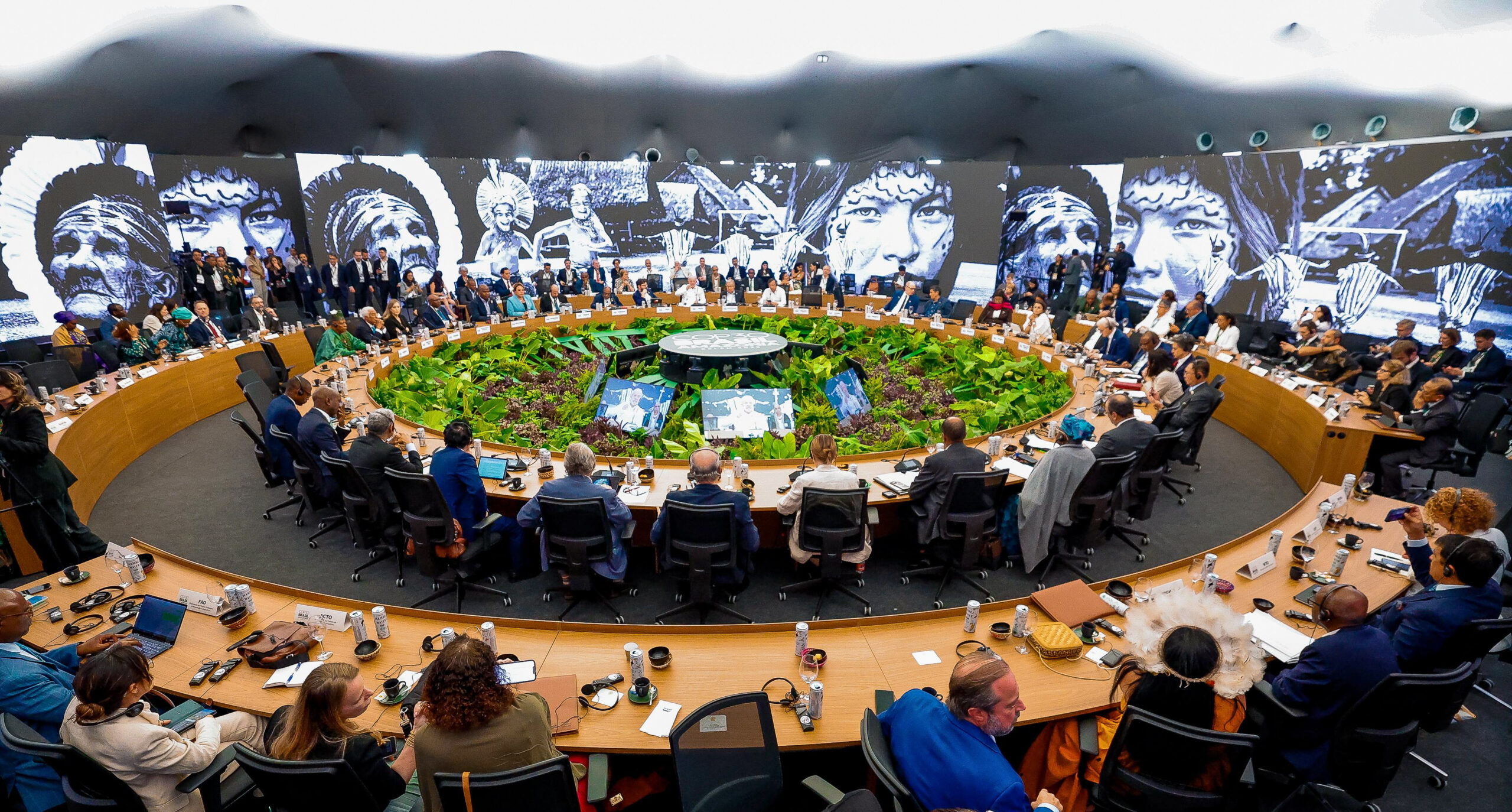
In November 2025, the 30th Conference of the Parties (COP30) was held in Belém (Brazil). The first to be held in the Amazon jungle, this name is laden with symbolism, since this ecosystem is both essential for global climate balance and, at the same time, is highly vulnerable.
The conferences are reserved for representatives from governments who renew their climate commitments while there, but players from civil society, scientists, non-governmental organisations, and others, also participate. Their voice is essential. While they cannot vote on the commitments undertaken by the countries, they can make their voices heard in the different forums held over the course of the COP. Voices like Gilberto Gil’s, musician and former Minister of Culture of Brazil who attended with Conservation International under the campaign “Conservation is Our Art”. He extended an invitation to preserve nature in a positive, hopeful tone, and his song Refloresta is a good example of this.
Although the context bears nuance, the COP 30 delivered lukewarm results in terms of achieving a roadmap to which all countries agree. As a whole, the decisions they reached are insufficient to spur appropriate action when considering that the Paris Agreement is ten years old.
As a counterpoint, they did agree to mobilise 1.3 trillion dollars per year for climate action by 2035, with developed countries bearing the lion’s share, and to triple funding for adaptation by that same year. For the first time, the final decision acknowledges that we must address climate misinformation and commits to promoting the integrity of information and taking action against discourse that undermines science-based actions.
Although the effectiveness of these international debates leaves room for doubt, we find hope in cases like successfully protecting the atmosphere’s ozone layer, a global common that makes planet Earth inhabitable. In the late 20th century, the emission of certain substances (like chlorofluorocarbons, or CFCs, used in air conditioners and aerosols), caused what we called the hole in the ozone layer. The Montreal Protocol (1987) moved countries to prohibit 99% of production and consumption of substances that were depleting the ozone layer. Today, the hole is clearly shrinking. This is thanks to the international reaction, during the first United Nations agreement in history that achieved universal ratification: 197 countries have signed this protocol.
Scientists warned us and sounded the alarm. This led to political decisions with science-aligned solutions that nations around the world implemented as urgent measures.
“We cannot prevent this catastrophe alone. But together, we can. By setting stronger targets, moving on faster timelines, and making deeper commitments” (Katharine Hayhoe, Climate Summit 2025).